
Soviet USSR TOZ-43 Tank Fire Protective Suit: Technical History of the Wartime Flame-Resistant Tanker Outfit
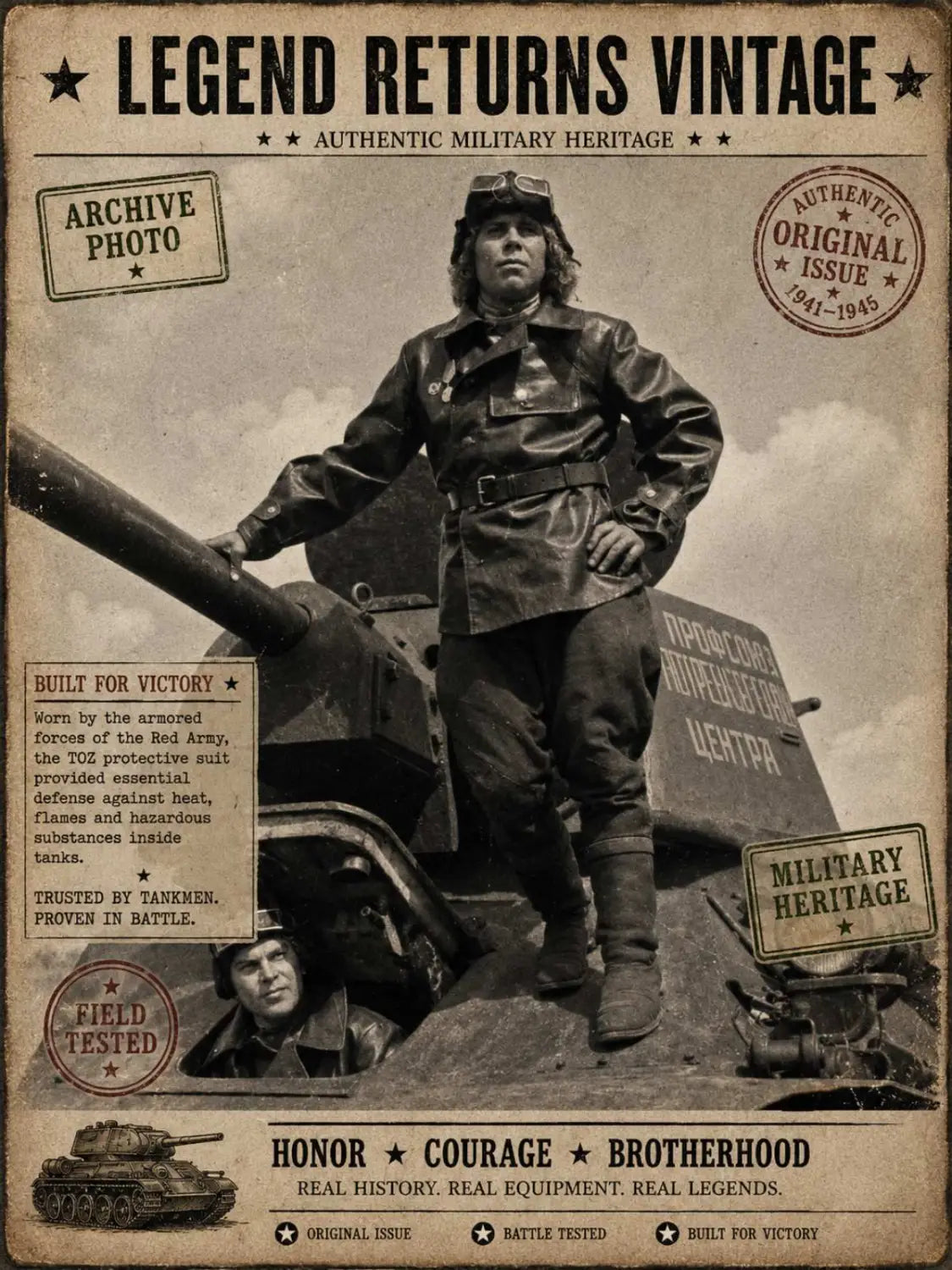
The Soviet TOZ-43 tank fire protective suit was a specialized flame-resistant clothing system developed during the Second World War for armored vehicle crews exposed to burning fuel, incendiary mixtures, engine fires, ammunition flash, and the extreme thermal hazards of damaged tanks. The abbreviation TOZ is commonly understood as Tank Fire Protective clothing, and the 1943 index reflects the wartime period in which the system entered practical supply.
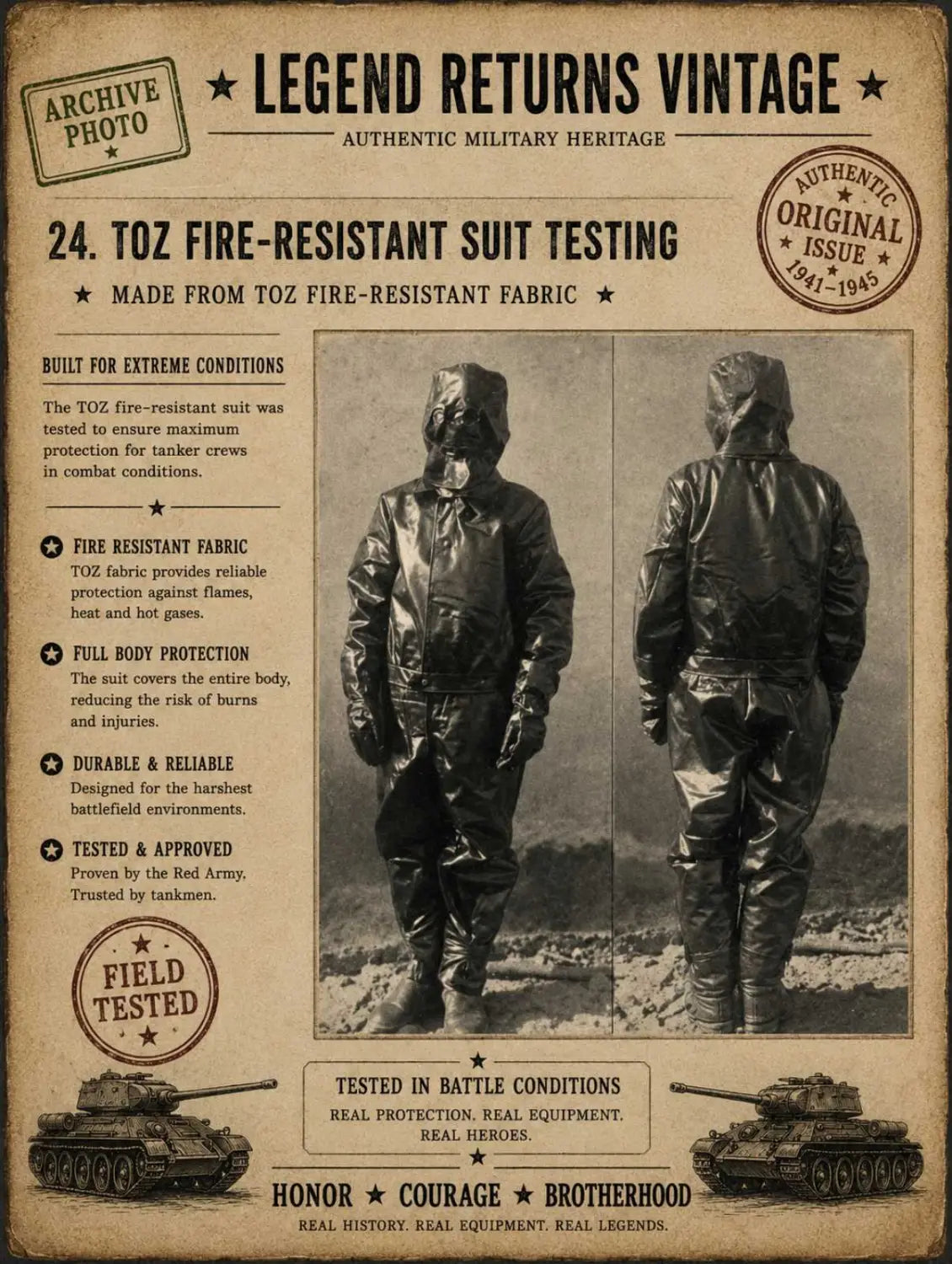
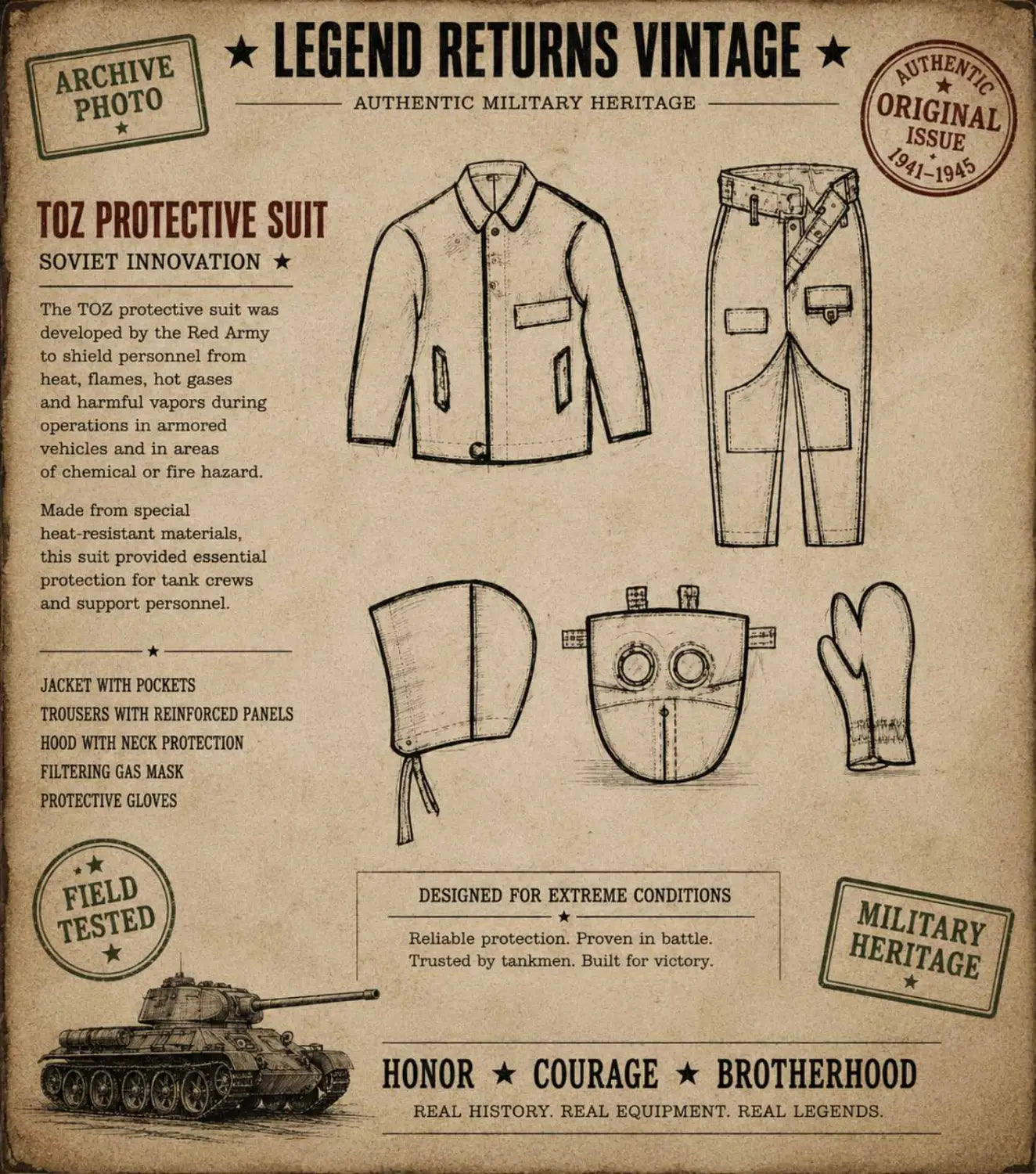
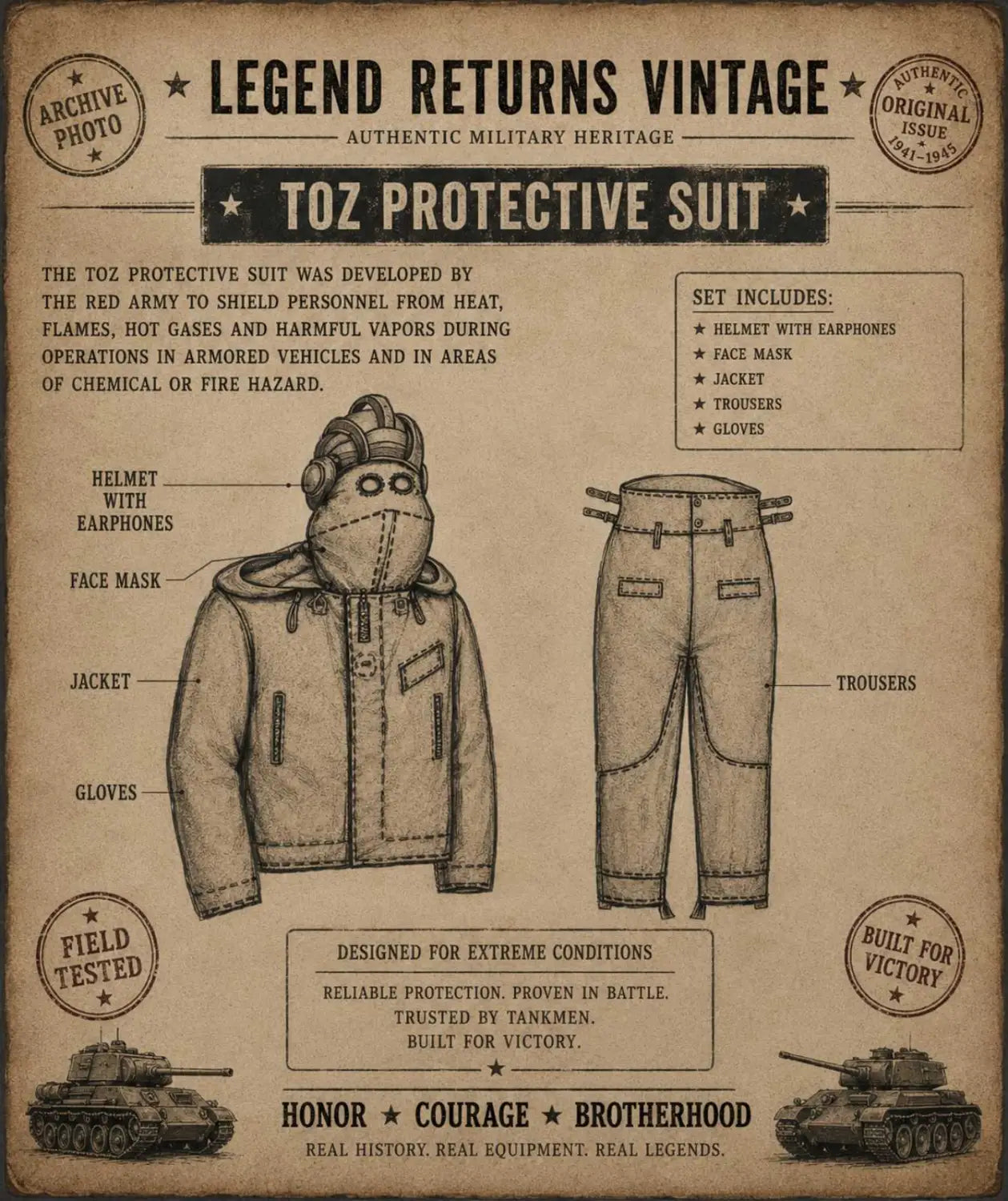
The complete TOZ concept was built around four protective elements: a heavy flame-resistant jacket with hood, high protective trousers or semi-overalls, a removable face mask with narrow eye openings, and long gauntlet-style mittens. Its purpose was not comfort or appearance, but survival during the first critical seconds of a vehicle fire.
👉 Looking for the real deal? You can buy the Soviet Tank Crew Winter Suit Black Military Jacket Pants Gloves Mask USSR here at Legend Returns Vintage.
Definition and Historical Role
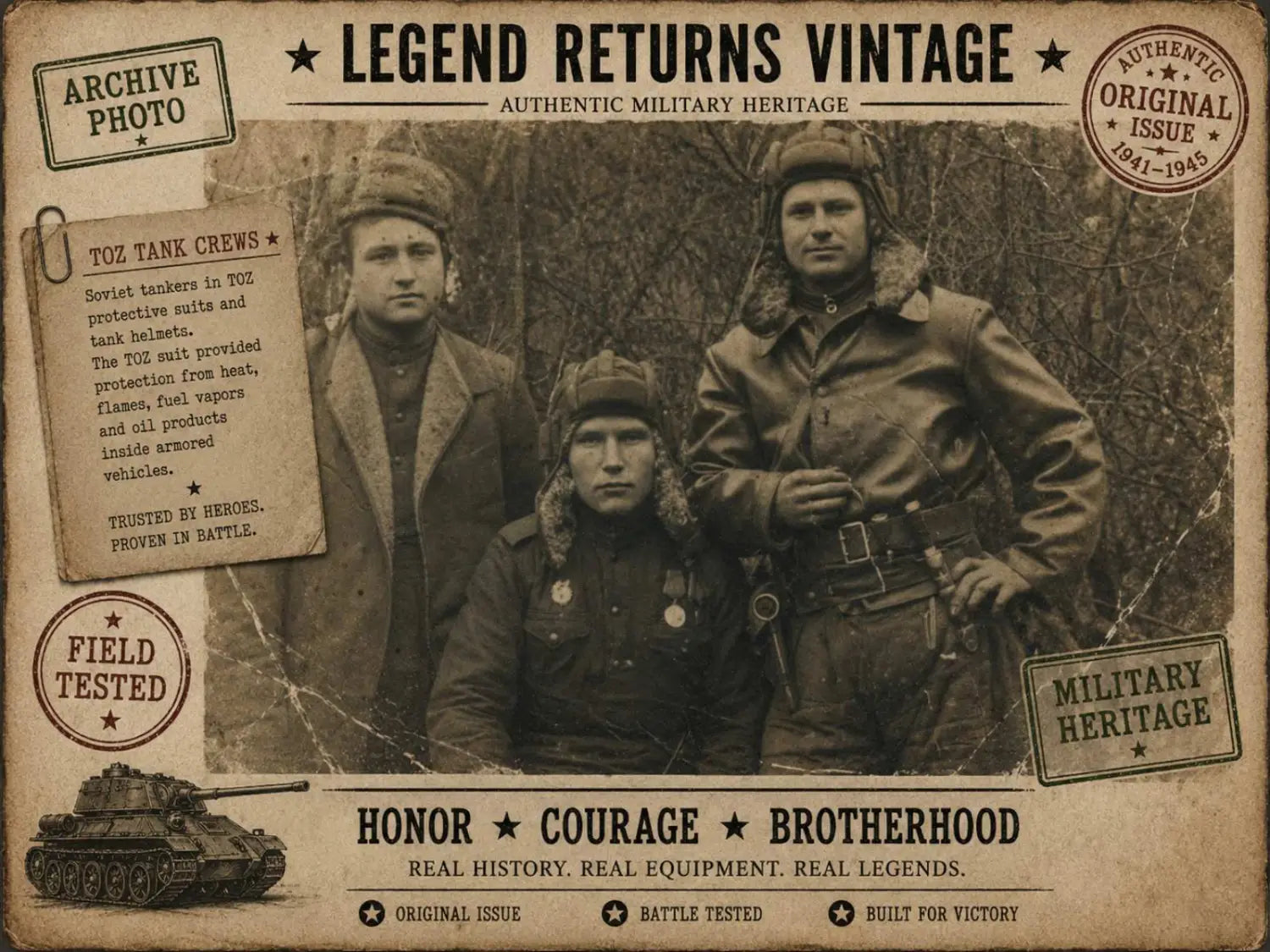
The TOZ-43 suit belonged to a narrow category of Soviet protective clothing created for tank crews operating in conditions where fire was one of the most dangerous battlefield threats. A tank could be disabled by armor penetration, fuel ignition, engine compartment fire, burning oil, incendiary liquid, or internal ammunition flash. In such a situation, the difference between survival and fatal injury could be measured in seconds.
Unlike ordinary cotton uniforms, leather jackets, padded winter clothing, or standard overalls, the TOZ suit was intended to resist brief direct flame contact and reduce thermal injury during evacuation. Its heavy fabric, treated surface, sealed cuffs, high trousers, hood, mask, and gauntlets worked together as a protective barrier around the body.
Why Soviet Tank Crews Needed Fire Protective Clothing
Armored vehicles of the 1940s created a uniquely dangerous environment. A crew worked inside a tight steel hull filled with fuel lines, electrical wiring, ammunition, lubricants, hot engine components, optics, radio equipment, and sharp interior fittings. When fire entered that environment, ordinary clothing could ignite quickly or transmit heat directly to the skin.
Tank crews also faced external hazards. Burning fuel could spread across armor plates, hatches, engine decks, and turret surfaces. A crew member escaping through a hatch might pass through flame, smoke, hot metal, and burning liquid. Protective clothing therefore needed to cover not only the torso, but also the face, hands, wrists, legs, and lower body.
Development During 1941–1943
The development of Soviet tank fire protective clothing accelerated during 1941–1942, when battlefield experience showed the vulnerability of armored crews to burns. Research was associated with Soviet military chemical-defense institutions and textile-industry specialists, whose task was to create a fabric that could resist flame better than ordinary cotton while still being manufacturable in wartime conditions.
The wartime solution was practical rather than elegant: an extremely dense cotton base, treated with flame-retardant compounds and protected by an outer film-like coating. The result was heavy, stiff, windproof, water-resistant while the surface remained intact, and visually close to thick black coated leather.
The TOZ-43 Index
The designation TOZ-43 is associated with the 1943 stage of adoption and supply. By this period, the suit had moved beyond laboratory experimentation and into practical use. It was connected especially with crews of flame-throwing tanks, assault tank units, and heavy armored formations where the risk of fire was especially serious.
The index also reflects a broader Soviet wartime pattern: specialized protective equipment was created when battlefield losses revealed a specific technical problem. The TOZ suit was not a fashion item, not a parade garment, and not an ordinary winter outfit. It was emergency survival equipment for a dangerous armored environment.
Institutions and Research Background
Development is commonly linked with Soviet chemical-defense research and the textile industry. This combination was logical. Flame protection required chemical knowledge, while large-scale production required textile technology, fabric finishing, cutting standards, and supply-chain organization.
The Soviet Union already had experience with protective clothing for chemical-defense troops, industrial workers, and fuel-handling personnel. TOZ adapted this technical direction to the specific needs of tank crews: short exposure to intense heat, protection from burning petroleum products, and the need to move through small vehicle hatches.
Fabric Base
The base material of the wartime TOZ suit was a very dense cotton fabric, often described in collector and technical discussions as similar to heavy moleskin, canvas, or high-density duck cloth. Cotton was widely available, familiar to Soviet textile factories, and easier to process at scale than more exotic fibers.
On its own, cotton burns. The importance of TOZ was not the cotton itself, but the way the textile was treated. Dense weave slowed heat transfer and improved mechanical strength, while chemical treatment changed how the fibers behaved under flame exposure.
Flame-Retardant Treatment
Wartime flame-retardant textile treatments often relied on mineral salts and chemical compounds that interfered with combustion. The purpose was to reduce ignition, slow flame spread, and encourage charring rather than open burning. Period-style descriptions often refer to ammonium salts, borates, and related flame-retardant chemistry as the type of technology available in that era.
For the TOZ suit, the practical result mattered more than the exact formula: the material had to survive short flame contact long enough for a tanker to extinguish burning liquid, climb out of a vehicle, or pass through a fire zone without immediate catastrophic burns.
Outer Film Coating
The distinctive appearance of many TOZ suits came from an outer coating. This layer gave the fabric a black, slightly glossy, heavy, almost leather-like look. It also helped protect the internal flame-retardant treatment from moisture and wear.
This coating was one of the suit’s strengths and also one of its weaknesses. When intact, it helped repel water, wind, oil, dirt, and burning liquid. When cracked, worn, or repeatedly soaked, it could lose integrity, allowing moisture to damage or wash out the protective chemistry beneath.
Color and Visual Appearance
The most recognized TOZ suits are black or very dark charcoal. This color was practical because tank service involved oil, soot, grease, fuel, mud, and smoke. Black material hid stains better than light fabric and visually matched the industrial character of armored vehicle work.
Some later or variant examples are known in protective khaki, sand, mustard, or light olive tones, especially in postwar and industrial protective clothing. The wartime black TOZ remains the most visually iconic version because of its association with armored crews and period photographs.
Jacket Construction
The TOZ jacket was the central element of the set. It was cut to cover the upper body with minimal open gaps. The hood was deep and designed to protect the head and neck area. In wartime logic, it also needed to fit over or around tank crew headgear and communication equipment.
The cuffs were designed to close tightly around the wrists. This detail was critical. Fire protection fails quickly when flame, hot air, or burning liquid enters through sleeve openings. Adjustable cuffs, straps, buttons, and reinforced closures helped reduce that risk.
Protective Trousers and Semi-Overalls
The trousers were usually made as high protective pants or semi-overalls rising toward the chest. This design protected the waist and lower torso better than ordinary trousers. It also reduced the chance of exposed fabric gaps between jacket and pants when the tanker bent, climbed, or crawled.
The lower leg sections were intended to close over boots. Tightening the bottoms helped prevent burning liquid, sparks, or flame from entering the trouser leg. In armored vehicle escape conditions, such details could matter greatly.
Face Mask
The removable face mask was one of the most dramatic parts of the complete TOZ set. It protected the face from flash flame, radiant heat, smoke contact, and burning droplets. Narrow eye openings allowed limited vision while reducing exposed skin.
In practice, masks were often uncomfortable and restrictive. Visibility, breathing, heat buildup, and communication were all affected. For this reason, surviving accounts and collector observations suggest that complete use of the mask was less common than use of the jacket alone.
Gauntlet Mittens
The long protective mittens or gauntlets were intended to protect the hands and wrists. Hands were especially vulnerable because tankers used them to open hatches, touch hot metal, move equipment, handle tools, and push away burning material.
The gauntlet length helped cover the gap between glove and sleeve. In emergency fire conditions, a short glove would leave the wrist exposed. The TOZ mitten design followed the same principle as industrial fire and welding protection: coverage must overlap.
Production and Supply
TOZ production was limited compared with ordinary Soviet uniforms. It was specialized protective clothing, not universal tanker dress. Available figures in collector and historical discussions often place wartime production in the tens of thousands rather than millions, which helps explain its rarity today.
Supply priority appears to have been connected with high-risk armored units, including flame-throwing tank crews and heavy breakthrough formations. Such crews faced a greater probability of fire exposure due to combat role, fuel load, vehicle type, and battlefield conditions.
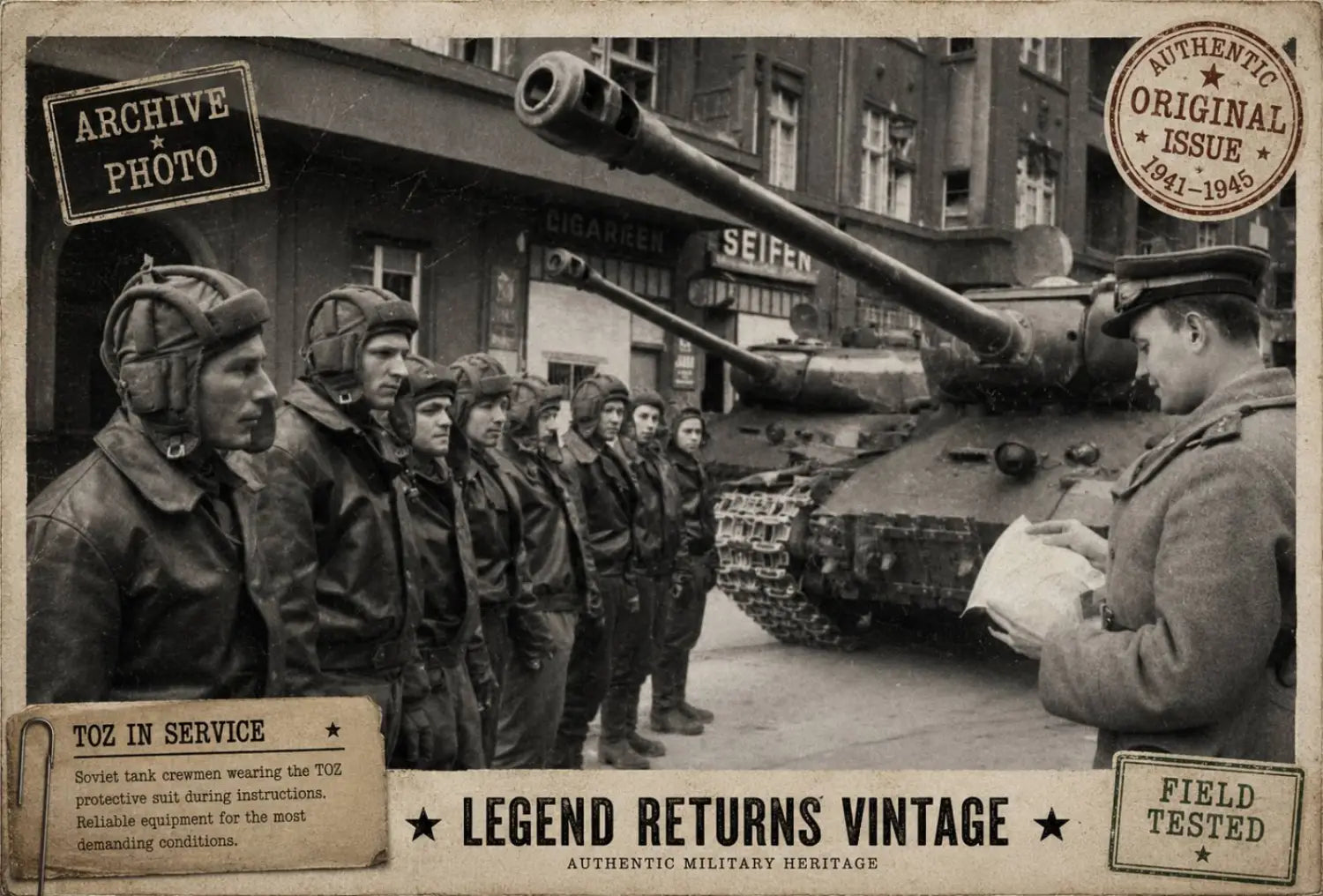
Testing and Frontline Evaluation
Testing took place during the wartime period, with references often pointing to 1942–1943 and combat-related evaluation in front conditions. The purpose was to determine whether the fabric and garment construction could protect crews against flame, burning liquid, and short-term thermal exposure.
Frontline testing was essential because laboratory flame resistance alone did not answer practical questions. A useful tank protective suit had to be wearable, movable, manufacturable, and capable of surviving mud, rain, fuel, oil, storage, and repeated handling.
Baptism of Fire: TOZ-43 During World War II
The TOZ-43 entered a battlefield environment in which tank crews needed every possible advantage against fire. Flame-throwing tanks such as OT-34 and KV-8 carried incendiary systems and operated close to enemy positions, increasing the risk of fire, fuel ignition, and burning-liquid exposure.
Heavy assault tanks and breakthrough formations also operated in dangerous conditions. Their crews could be exposed to burning fuel, internal flash, engine fires, and smoke while fighting in dense defensive zones. The TOZ suit was therefore a technical response to the lived reality of armored combat.
Practical Use Inside the Tank
The complete TOZ set was protective, but it was also heavy, stiff, hot, and restrictive. Tank crews already worked in cramped interiors, often under stress, vibration, smoke, noise, and heat. Wearing a full coated fire-protective suit could reduce comfort and mobility.
As a result, the jacket became the most commonly appreciated element. It was durable, windproof, and useful in cold weather. The mask and full trousers, while protective, were more likely to be set aside unless the crew expected a specific fire hazard.
Why the Jacket Was Valued
The TOZ jacket had qualities that made it valuable beyond its fire-protective role. It blocked wind, resisted grime, handled rough service, and gave warmth when layered over other clothing. In cold conditions, a stiff black coated jacket could be more useful than ordinary cotton outerwear.
This explains why wartime photographs sometimes show tankers wearing TOZ jackets without the full protective set. Real frontline use often transforms specialized equipment into practical clothing when soldiers discover which parts are most useful day to day.
Weaknesses of the Wartime Fabric
The major weakness of early TOZ fabric was the durability of the protective coating and chemical treatment under wet conditions. If the outer film cracked or peeled, water could penetrate into the textile structure. Repeated soaking could reduce the effectiveness of the flame-retardant treatment.
This weakness was not unusual for the period. Many early flame-resistant textiles depended on treatments that were vulnerable to washing, moisture, abrasion, or aging. Permanent flame-resistant synthetic fibers were not yet available in the same way they would be later in the twentieth century.
End of Part One
This first part covered the origin, construction, fabric technology, wartime purpose, and early use of the Soviet TOZ-43 tank fire protective suit. The second part continues with postwar modernization, the transformation of TOZ fabric into industrial protective workwear, collector identification, rarity, and historical value.
Frontline Experience and Operational Reality
Combat conditions quickly demonstrated that the TOZ-43 was unlike any ordinary field garment. Inside Soviet armored vehicles, temperatures could rise dramatically even without enemy action. Engines generated constant heat, ammunition racks occupied much of the fighting compartment, lubricants coated mechanical assemblies, and fuel tanks were positioned within the vehicle structure. During combat, a single penetrating hit could transform this confined space into an environment filled with burning fuel vapors, smoke, and rapidly increasing temperatures.
The TOZ-43 was therefore designed to provide valuable seconds rather than complete immunity. Soviet engineers understood that no textile could protect indefinitely against an intense fire inside a burning tank. Instead, the objective was to delay severe burns long enough for a crew member to extinguish flames, assist fellow crewmen, or escape through the turret or driver's hatch.
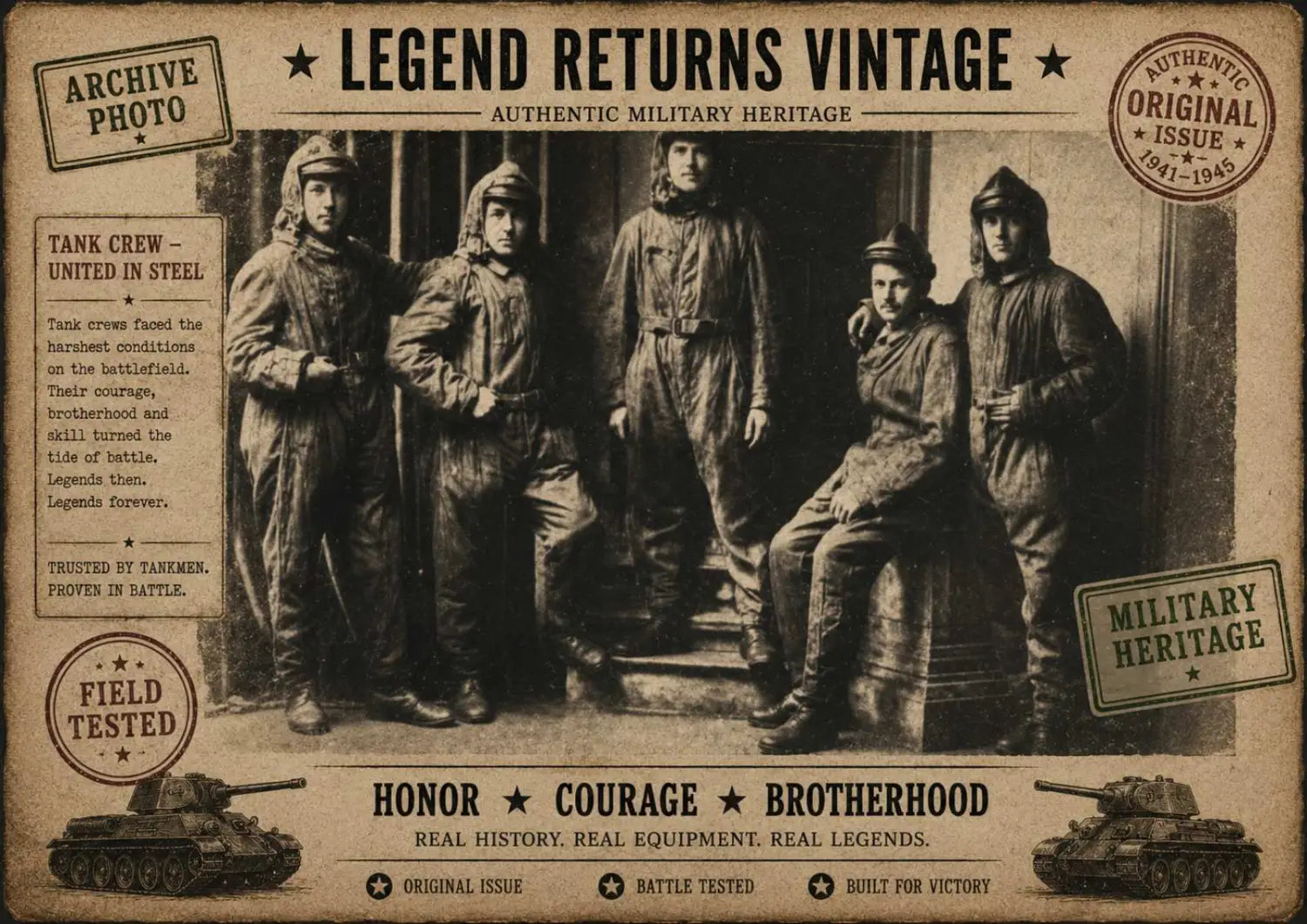
Trials Under Battlefield Conditions
Laboratory testing represented only the first stage of evaluation. Wartime conditions demanded practical verification under operational circumstances. Period documentation and historical research indicate that fire-protective clothing underwent field evaluation during 1942–1943, including testing by specialized armored formations operating under real combat conditions.
These evaluations focused on mobility, durability, resistance to flame exposure, compatibility with existing tanker equipment, and the ability of crews to continue operating radios, weapons, optics, and vehicle controls while wearing protective clothing. Engineers also monitored how the treated fabric behaved after repeated exposure to rain, mud, engine oil, lubricants, and prolonged storage.
The Human Factor
Although technically effective, the complete TOZ-43 ensemble presented practical difficulties. The dense treated fabric was considerably heavier than ordinary cotton uniforms and restricted body movement inside already cramped armored vehicles. Ventilation was minimal, causing heat accumulation during long periods of operation.
As a consequence, many crews adapted the equipment according to operational needs. Historical accounts suggest that the jacket became the most frequently worn component, while the protective mask and heavy trousers were often carried inside the vehicle for emergency use rather than worn continuously throughout a mission.
Why the Jacket Became the Most Popular Element
The fire-resistant jacket earned particular respect among tank crews. Beyond its intended protective function, it proved exceptionally resistant to wind, mechanical wear, mud, grease, and rough daily service. During winter operations it offered excellent protection against freezing air entering through open hatches while remaining durable enough to withstand constant contact with steel surfaces.
This practical value explains why wartime photographs frequently show Soviet tank crews wearing TOZ jackets independently of the remaining protective components. Soldiers naturally favored equipment that combined protection with everyday usefulness.
Protecting Against Burning Fuel
One of the greatest dangers facing armored crews was not simply open flame but burning petroleum products. Fuel ignited differently from ordinary combustible materials, adhering to metal surfaces and spreading rapidly across armor plates. Escaping through burning fuel without specialized clothing exposed crews to devastating thermal injuries.
The treated surface of the TOZ fabric was intended to reduce direct flame spread across the garment while providing sufficient insulation for rapid evacuation. Long gauntlets protected the hands when opening heated hatches or brushing burning fuel away from equipment, while the hood and face covering reduced exposure of vulnerable skin.
Fire Inside Armored Vehicles
Contrary to popular belief, many tank fires began not as dramatic explosions but as localized ignition. Electrical short circuits, ruptured fuel lines, leaking lubricants, hydraulic fluids, damaged ammunition storage, and engine compartment failures could all create conditions where smoke and heat increased rapidly before flames engulfed the interior.
Such situations demanded immediate reaction. Every second gained through protective clothing increased the probability of survival, especially when assisting injured crew members or attempting to extinguish localized fires before abandoning the vehicle.
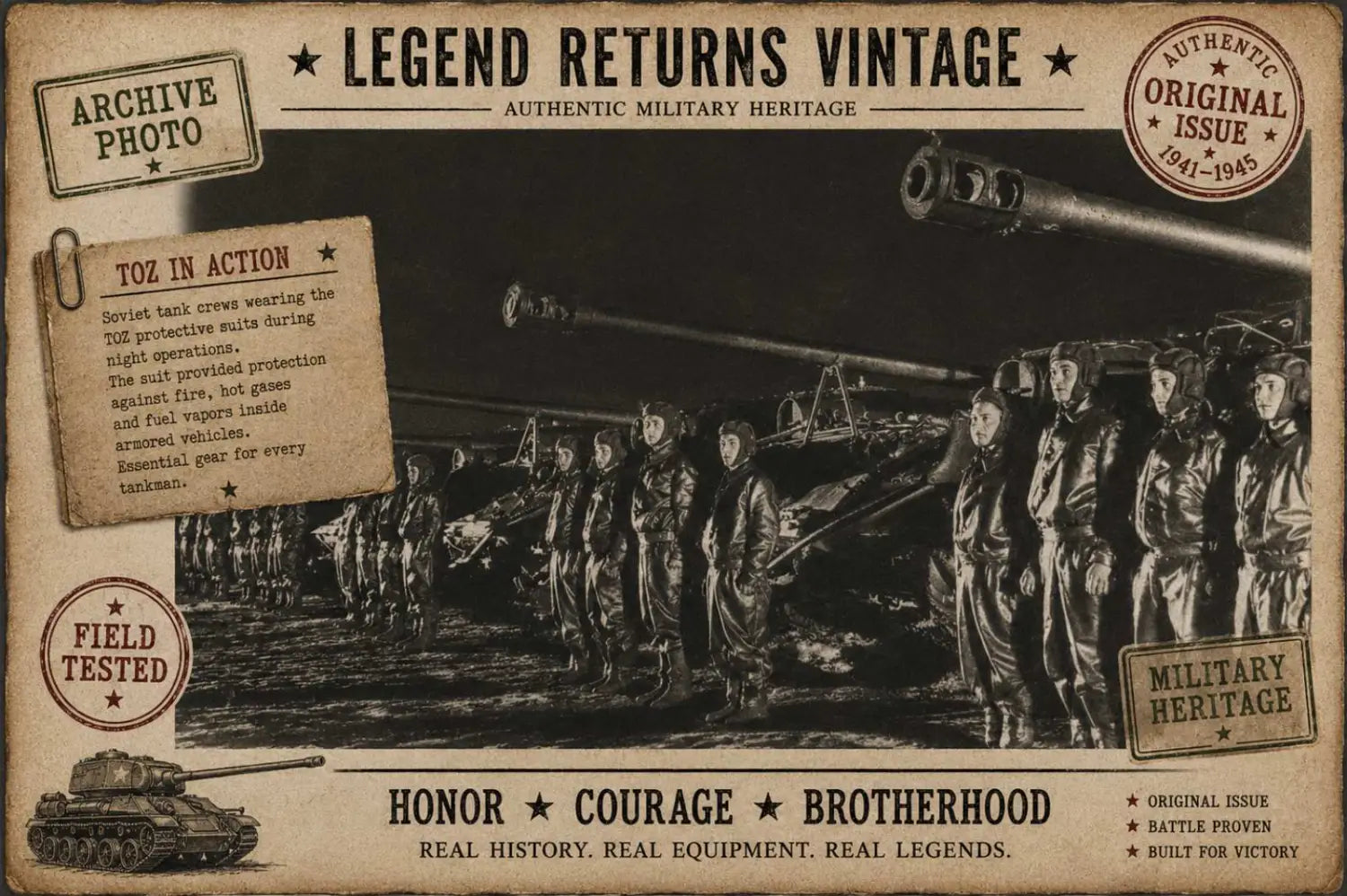
Comparison with Contemporary Foreign Developments
During the Second World War, several nations experimented with protective clothing for armored crews. However, priorities differed considerably. German armored crews generally relied on black wool uniforms that offered limited natural resistance to sparks but were not specifically engineered as dedicated flame-protective systems. British and American tank uniforms focused primarily on comfort, mobility, and identification rather than specialized thermal protection.
The Soviet TOZ concept therefore occupied a distinctive niche. Rather than serving as ordinary service clothing, it represented specialized emergency equipment developed specifically to improve survival during fire-related incidents inside armored vehicles.
Manufacturing Challenges During Wartime
Producing TOZ garments during wartime placed considerable demands upon Soviet industry. Heavy cotton fabric required multiple stages of treatment before final assembly. Each garment then needed precise cutting, reinforced stitching, chemical processing, drying, inspection, and quality control before delivery to military supply depots.
Factories simultaneously faced shortages of labor, chemicals, transportation capacity, and raw materials. Despite these challenges, specialized production continued because protecting experienced armored crews represented a strategic priority.
Construction Details That Increased Protection
Many seemingly simple design elements reflected careful engineering. Deep overlapping fronts reduced exposed openings. Tight cuffs prevented flames from entering sleeves. High-waisted trousers eliminated gaps around the waist during movement. The generous hood accommodated tanker communication helmets while protecting the neck and shoulders.
Even button placement and seam reinforcement contributed to overall performance. Double stitching improved durability, while robust thread reduced seam failure under repeated mechanical stress.
Chemical Aging and Material Degradation
One of the principal weaknesses of early flame-resistant coatings involved long-term environmental exposure. Moisture gradually affected the integrity of the protective surface. Once the outer layer cracked, repeated wetting could reduce the effectiveness of the flame-retardant treatment contained within the fabric structure.
This limitation reflected the technological realities of the early 1940s rather than poor engineering. Durable synthetic flame-resistant fibers had not yet entered widespread military production, requiring engineers to achieve protection through chemical treatment of natural textiles.
The Famous IS-2 "Kolyma" Crew
Among the most recognizable wartime photographs connected with TOZ equipment are images of the crew of the IS-2 heavy tank Kolyma, commanded by Aleksandra Boyko. Period photographs clearly show crew members wearing characteristic TOZ jackets, demonstrating that the protective garment had become an accepted part of operational equipment within certain heavy armored formations.
These images remain among the best-known visual references for historians studying wartime Soviet protective clothing and provide valuable evidence of how the garments appeared during actual service.
Limited Production and Present-Day Rarity
Unlike ordinary uniforms produced in enormous quantities, TOZ protective clothing remained highly specialized. Distribution focused on units considered to face elevated fire risks rather than the entire armored force. Consequently, comparatively few complete wartime sets survived.
Many garments continued to serve after the war, while others were modified, repaired, repurposed, or discarded following years of industrial use. Complete original wartime examples with jacket, trousers, face mask, and gauntlets are therefore exceptionally difficult to locate today.
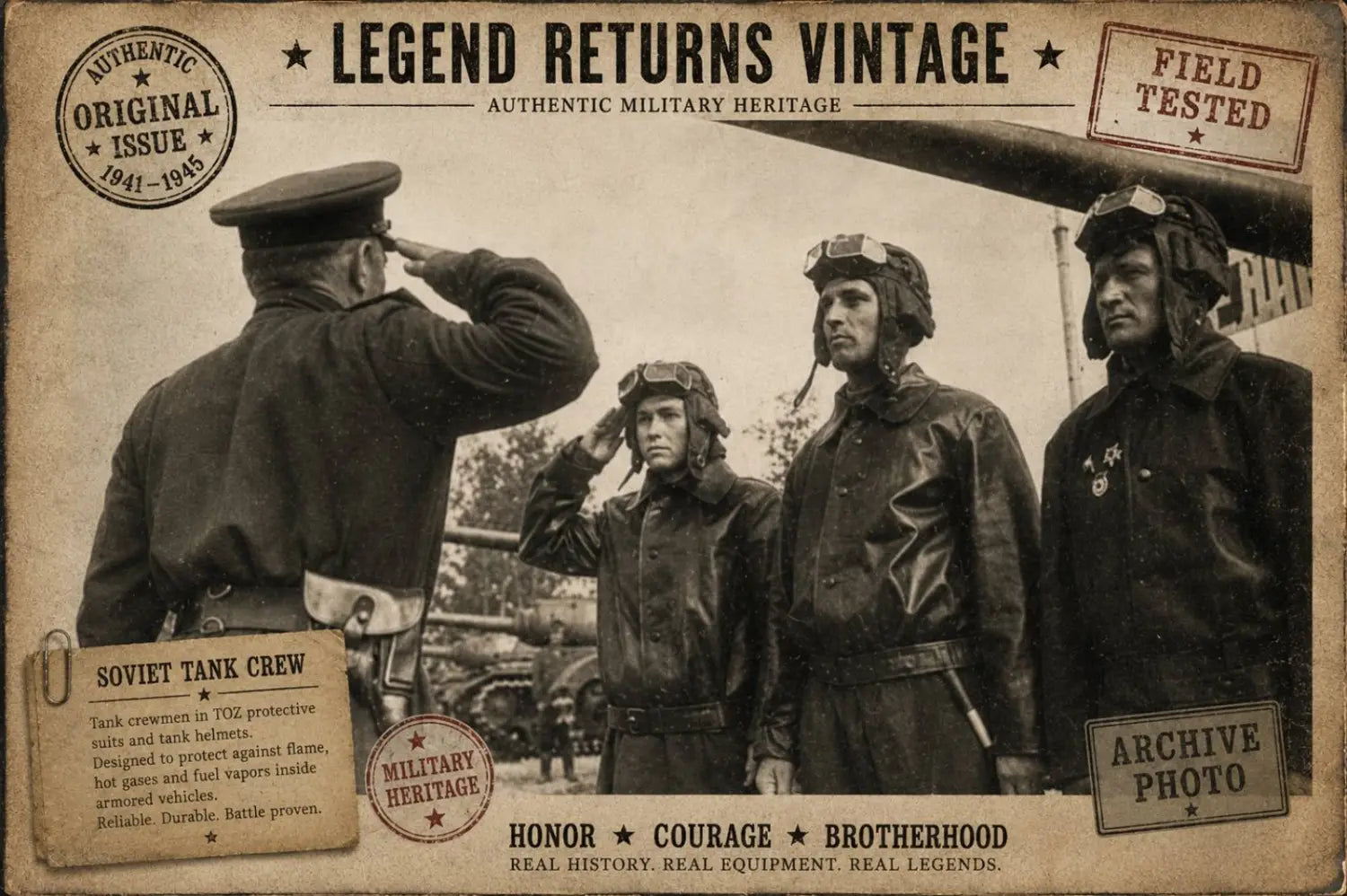
Transition Toward Postwar Development
Experience gained during the Second World War did not disappear with the end of hostilities. Engineers continued studying flame-resistant fabrics, improved chemical treatments, and more durable protective coatings. Although later generations of TOZ clothing evolved considerably, the central concept remained unchanged: protecting personnel working in environments where fire represented an occupational hazard.
The postwar decades would transform TOZ technology from a specialized wartime survival system into one of the Soviet Union's most recognizable categories of industrial protective clothing, laying the foundation for an entirely new generation of fire-resistant workwear.
The Second Life of TOZ Technology After the War
The end of the Second World War did not mark the end of TOZ technology. Instead, wartime experience became the foundation for several decades of Soviet research into flame-resistant protective clothing. Military engineers had proven that chemically treated dense cotton fabrics could significantly reduce burn injuries during short-term flame exposure. The challenge after 1945 was improving durability, flexibility, and resistance to moisture without sacrificing protective performance.
Throughout the late 1940s and 1950s, Soviet chemical laboratories continued refining fire-resistant textile treatments. New formulations gradually reduced one of the principal weaknesses of wartime TOZ garments—the tendency of the outer protective coating to crack after prolonged exposure to moisture, repeated folding, and long-term storage.
Modernization During the 1950s–1980s
By the 1970s, protective clothing technology had advanced considerably. Soviet industry introduced improved impregnating compounds based on more stable silicone and fluorinated chemical systems that offered better water repellency while maintaining flame-resistant properties. Unlike the early wartime coatings, these newer treatments remained effective after repeated exposure to moisture and moderate cleaning.
The fabric itself retained its characteristic heavy feel. Workers frequently described it as extremely stiff when new, requiring weeks or months of regular wear before becoming more flexible. Although still uncomfortable compared with ordinary work clothing, its durability became legendary.
Transformation Into Industrial Protective Clothing
As armored vehicle technology evolved and newer tanker clothing entered military service, TOZ fabric found an entirely new role within Soviet industry. Flame-resistant garments became standard protective equipment for welders, foundry workers, repair depots, fuel storage facilities, heavy engineering plants, shipyards, and railway maintenance organizations.
This transition represented an unusual example of wartime innovation finding widespread civilian application. A technology originally developed to improve battlefield survival became one of the most recognizable forms of Soviet industrial protective clothing.
Changes in Garment Design
Later TOZ garments differed noticeably from their wartime predecessors. Protective face masks disappeared from standard sets because industrial workers required unrestricted visibility and communication. Jackets gained practical cargo pockets with protective flaps designed to prevent sparks and molten metal from entering.
Ventilation also improved. Engineers introduced metal eyelets, concealed air channels, and ventilation openings beneath shoulder yokes to reduce heat accumulation. Hidden fastening systems gradually replaced exposed buttons, minimizing the possibility of catching molten metal droplets during welding operations.
Improved Fabric Technology
The greatest engineering achievement of the postwar generations lay inside the fabric itself. Rather than relying upon a fragile external film, later treatments penetrated deeper into the textile structure while remaining significantly more resistant to weathering. Water repellency improved dramatically, and the garments tolerated years of professional use under difficult industrial conditions.
Although still heavy compared with ordinary cotton workwear, later TOZ clothing represented a substantial technological improvement over the original wartime models while preserving the same philosophy of protecting workers from sudden thermal hazards.
Recognizing an Original Wartime TOZ-43
Collectors examine numerous construction details when identifying authentic wartime examples. Original garments typically feature exceptionally dense coated fabric, reinforced seams sewn with heavy thread, period-correct buttons made from metal or early synthetic materials, and a generously sized hood intended to fit over Soviet tanker communication helmets.
Interior factory markings, inspection stamps, manufacturing dates, and period construction techniques often provide additional evidence of authenticity. As with many wartime textiles, markings may have faded after decades of storage or use, making overall construction quality equally important during identification.
Condition Assessment
Because TOZ garments relied upon chemical treatment, condition assessment extends beyond ordinary textile preservation. Collectors carefully inspect the surface for cracking, peeling, stiffness, delamination, and evidence of previous repairs. Light storage wear is expected and frequently considered part of the object's historical character.
Examples retaining their original surface finish without extensive deterioration are significantly less common than garments showing heavy industrial use. Complete sets including jacket, trousers, mittens, and protective face mask remain especially desirable due to their rarity.
Museum Significance
Today the TOZ-43 occupies an important place within museums dedicated to armored warfare, military technology, textile engineering, and twentieth-century industrial history. It illustrates how battlefield experience directly influenced protective clothing design and demonstrates the close relationship between chemistry, engineering, and military requirements.
For researchers, surviving examples provide valuable evidence regarding wartime manufacturing methods, material science, and Soviet approaches to crew survivability. Every original garment preserves construction techniques that cannot be fully understood through written documentation alone.
Importance for Collectors
Original TOZ-43 suits occupy a unique niche within Soviet militaria collecting. Unlike standard uniforms produced in vast numbers, fire-protective suits were specialized technical equipment manufactured in comparatively limited quantities and subjected to unusually demanding service conditions.
As a result, surviving examples attract collectors interested not only in military history but also in industrial technology, protective equipment, textile engineering, and the evolution of safety design during the twentieth century.
Legacy of the TOZ-43
The TOZ-43 demonstrates how military necessity accelerated innovation. Engineers confronted an immediate battlefield problem—the devastating effects of fire inside armored vehicles—and produced a practical solution using the materials and chemical knowledge available during wartime.
Although later technologies introduced synthetic flame-resistant fibers and advanced protective fabrics, the fundamental concept established by TOZ remained influential: properly engineered clothing could provide critical seconds that might determine whether a crew member survived a catastrophic vehicle fire.
Conclusion
The Soviet TOZ-43 Tank Fire Protective Suit represents one of the most technically fascinating protective garments developed during the Second World War. Combining dense textile construction, flame-retardant chemistry, and practical engineering, it reflected the Soviet determination to improve the survivability of armored vehicle crews operating under extreme battlefield conditions.
Its story did not end with victory in 1945. Through continuous modernization, TOZ technology evolved into one of the Soviet Union's most durable forms of industrial protective clothing, serving workers, engineers, welders, repair specialists, and maintenance personnel for decades. Today original wartime examples remain highly desirable historical artifacts, valued for their rarity, engineering significance, and direct connection to one of the most challenging environments faced by twentieth-century armored crews.
Preserve History. Own a Piece of the Past.
✦ Preserve History. Own a Piece of the Past. ✦
Discover authentic Soviet militaria at Legend Returns Vintage.
Carefully selected historical items for collectors, reenactors, museums, film productions, and vintage enthusiasts worldwide.