
Few items of Soviet military equipment became as famous, recognizable, and deeply woven into everyday life as the Kirza boot. For millions of people across the Soviet Union, these tall black boots were far more than simple footwear. They marched through war, helped rebuild cities destroyed by conflict, crossed muddy village roads, accompanied workers on construction sites, and became one of the most enduring symbols of Soviet life.
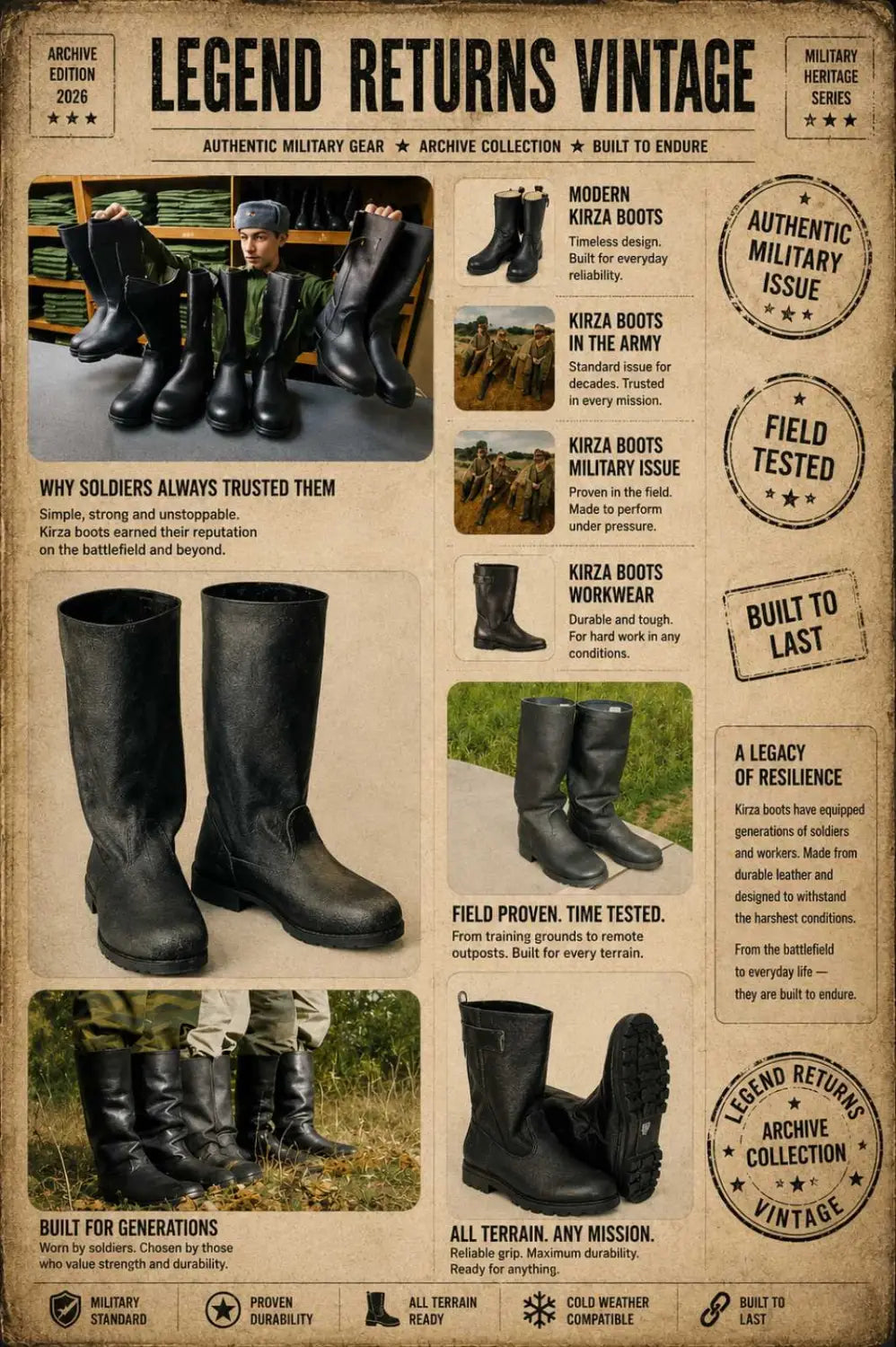
To understand why Kirza boots became legendary, it is important to understand the problem they were created to solve.
Throughout history, armies required enormous quantities of footwear. Leather boots were effective but expensive. Producing millions of pairs required vast amounts of natural leather, skilled labor, and considerable resources. For a country as large as the Soviet Union, finding a durable alternative became a strategic necessity.
The origins of Kirza can be traced back to the early twentieth century. In 1904, Russian inventor and military engineer Mikhail Pomortsev developed an innovative treated fabric intended to imitate some of the properties of natural leather. His material was created by impregnating strong textile fabric with special compounds that made it resistant to moisture while retaining flexibility. The invention showed promise, but technological limitations and historical events prevented widespread adoption.
After the Revolution and the formation of the Soviet Union, industrial development became one of the state's highest priorities. During the 1920s and 1930s, Soviet engineers searched for ways to reduce dependence on scarce raw materials while expanding production capacity. The need for affordable military footwear became increasingly urgent as the Red Army grew larger and more modern.
The breakthrough came through the development of synthetic rubber technology. Soviet scientists Boris Byzov and Sergei Lebedev played important roles in creating artificial rubber production methods that eventually made large-scale Kirza manufacturing possible. Building on earlier concepts, engineer Ivan Plotnikov and his colleagues developed an improved version of the material that combined multiple layers of cotton fabric with synthetic compounds. The result was a strong, flexible material that resembled leather while being far cheaper to produce.
Yet the road to success was far from smooth.
The first large-scale tests exposed serious weaknesses. During the Soviet-Finnish War of 1939–1940, early Kirza boots performed poorly in severe winter conditions. Extreme cold caused the material to become brittle and crack. Soldiers complained about durability issues, and many officials considered the project a failure.
Under normal circumstances, the story might have ended there.
History had other plans.
When the Soviet Union entered the Second World War in June 1941, the country faced an unprecedented logistical challenge. Millions of men were mobilized within months. The demand for uniforms, weapons, and footwear exploded overnight. There was simply not enough natural leather available to equip such a vast force.
Suddenly, Kirza became more important than ever.
Ivan Plotnikov and his team were ordered to solve the remaining problems as quickly as possible. Working under extraordinary pressure, they improved the formula and developed a new generation of Kirza material capable of withstanding harsh conditions. The updated material proved far more reliable, retaining flexibility while providing excellent resistance to moisture and wear.
The results transformed Soviet military logistics.
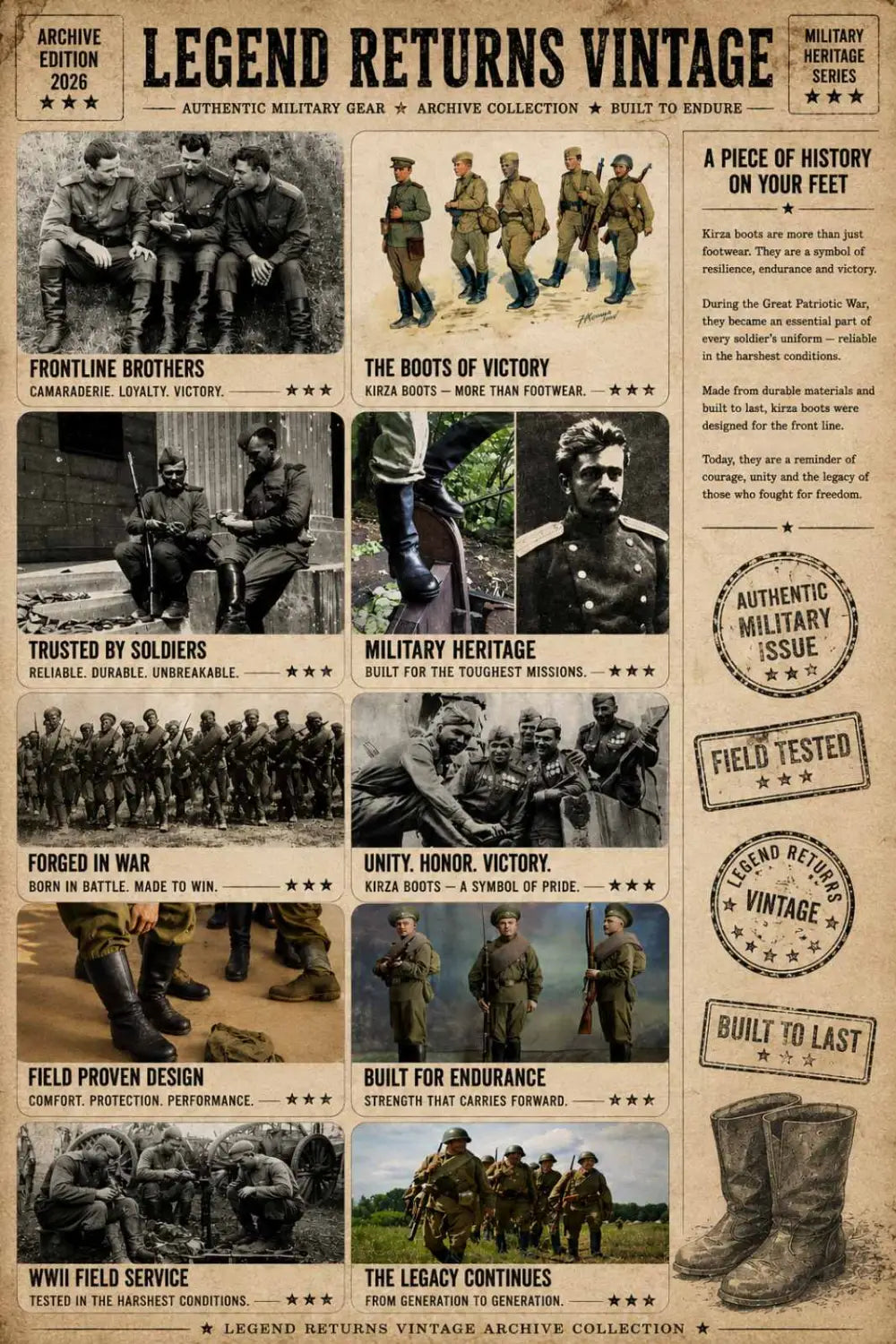
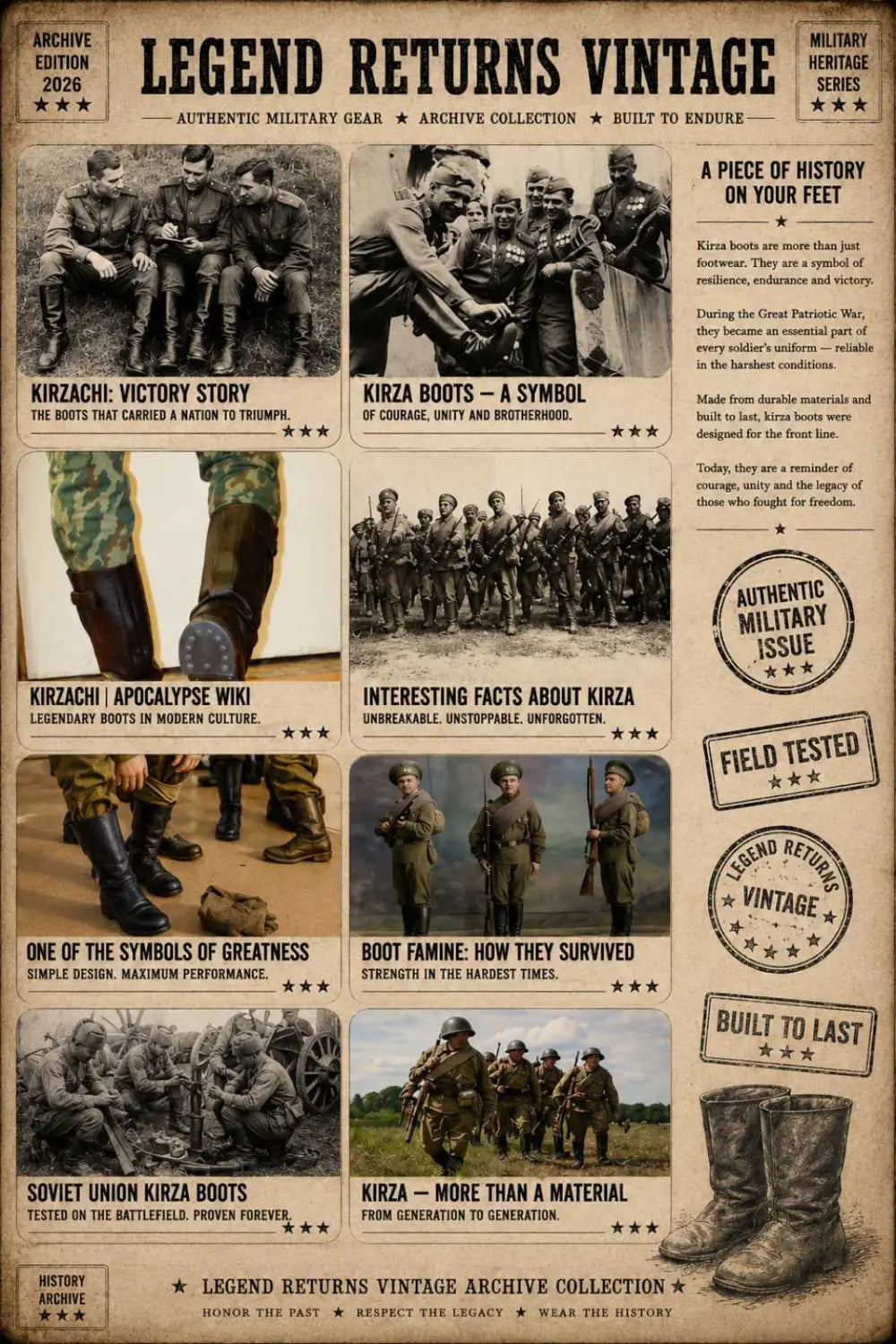
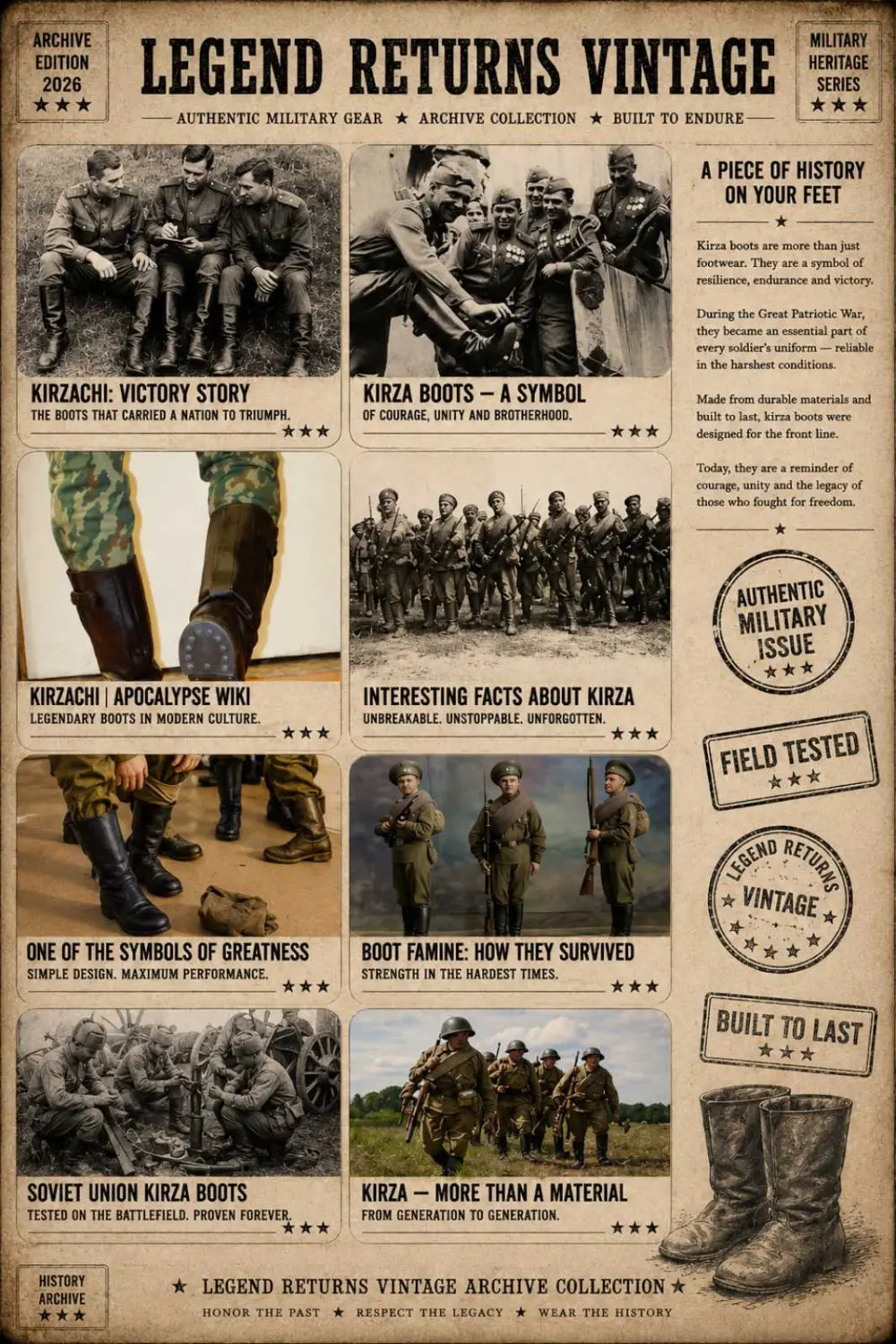
By the middle years of the war, Kirza boots were being produced in enormous quantities. Millions of soldiers received them. Historians estimate that roughly ten million Soviet servicemen wore Kirza boots during the war years alone. Few pieces of military equipment can claim such widespread service.
The design itself was brilliantly practical.
The lower portion of the boot, which experienced the greatest stress, was usually made from natural leather. The tall shaft was manufactured from Kirza material. This approach dramatically reduced leather consumption while maintaining durability where it mattered most.
The boots were inexpensive, strong, relatively easy to manufacture, and suitable for mass mobilization.
For a nation fighting one of the largest wars in human history, these advantages were invaluable.
However, the true secret behind the success of Kirza boots was not the boot alone.
It was the famous partnership between Kirza boots and portyanki.
To modern readers, foot wraps may seem unusual, but for generations of Soviet soldiers they were an essential part of military life. A properly wrapped portyanka offered remarkable advantages. Unlike socks, it could be adjusted easily, dried quickly, and reused repeatedly under difficult field conditions.
Experienced soldiers knew how to wrap them perfectly. If water entered the boot, the portyanka could simply be rewound using a dry section against the foot while the damp section moved outward where it would gradually dry. This practical system proved highly effective during long marches and field operations.
The combination of Kirza boots and portyanki became one of the most recognizable images of Soviet military service.
After the war ended in 1945, the story of the Kirza boot was only beginning.
The Soviet Union faced the enormous task of reconstruction. Entire cities needed rebuilding. Factories had to be restored. Roads, railways, farms, and industrial facilities required labor on an unprecedented scale.
Millions of civilians adopted the same boots that had served soldiers during wartime.
Workers wore them on construction sites.
Farmers wore them in fields.
Drivers wore them during long shifts.
Hunters, fishermen, mechanics, and laborers relied on them every day.
The reason was simple.
Kirza boots worked.
They handled mud, snow, rain, and rough terrain. They were affordable enough for ordinary people and durable enough to survive years of hard use. In many rural regions of the Soviet Union, Kirza boots became an essential part of daily life.
Throughout the Cold War, generations of young men encountered Kirza boots during military service. For many veterans, receiving their first pair became a memorable rite of passage. The distinctive smell of new boots, the challenge of learning to wrap portyanki correctly, and the experience of breaking in a fresh pair became shared memories across multiple generations.
As decades passed, the boots became something larger than footwear.
They became a cultural symbol.
Writers mentioned them.
Veterans remembered them.
Photographs preserved them.
Films featured them.
The word "Kirzachi" entered everyday speech and became instantly recognizable throughout the Soviet Union.
Unlike officer chrome boots, which often symbolized rank and prestige, Kirza boots represented endurance, practicality, and ordinary service. They belonged not to generals but to millions of ordinary people whose efforts shaped the history of the twentieth century.
Even during the later decades of the Soviet era, when newer footwear options appeared, Kirza boots remained in widespread use. Their low production cost and proven reliability ensured their continued presence throughout the armed forces and civilian sectors.
Following the dissolution of the Soviet Union in 1991, many military traditions gradually changed. Modern combat boots began replacing older designs. New materials entered the market. Yet Kirza boots continued to survive because they still offered something many modern products could not: simplicity, durability, and affordability.
Today, original Soviet Kirza boots have become highly collectible artifacts. Historians value them as tangible reminders of wartime production and Soviet industrial achievement. Reenactors seek authentic examples for historical accuracy. Museums preserve them as artifacts connected to the experiences of millions of ordinary people.
An authentic example of original Soviet Kirza boots can be viewed here:
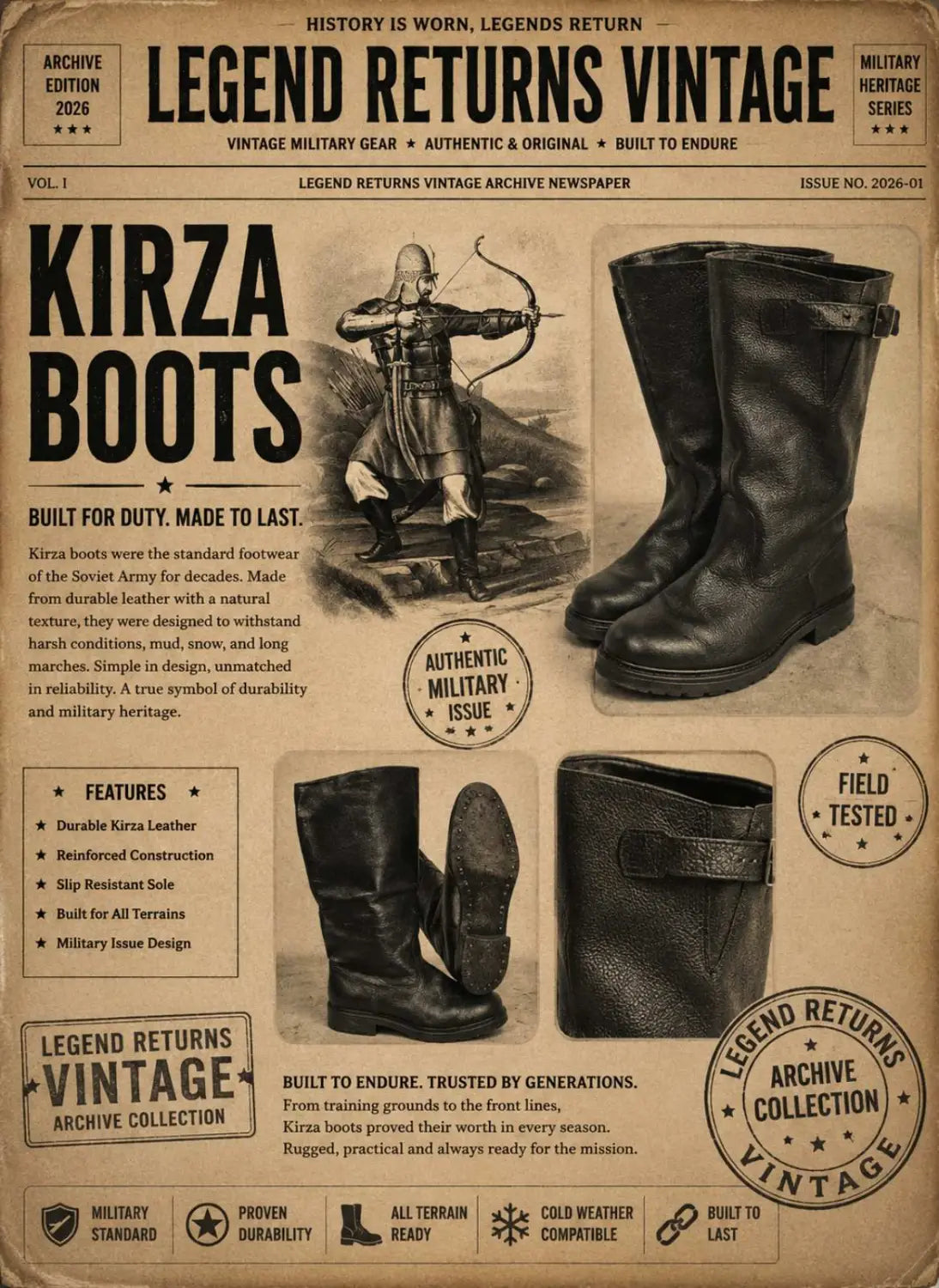
Collectors searching for preserved Soviet footwear and authentic historical artifacts often discover remarkable examples through Legend Returns Vintage, where original pieces connected to the history of the USSR continue to be preserved for future generations.
The story of the Kirza boot is not really a story about footwear.
It is a story about innovation born from necessity.
It is a story about engineers solving impossible problems under extraordinary circumstances.
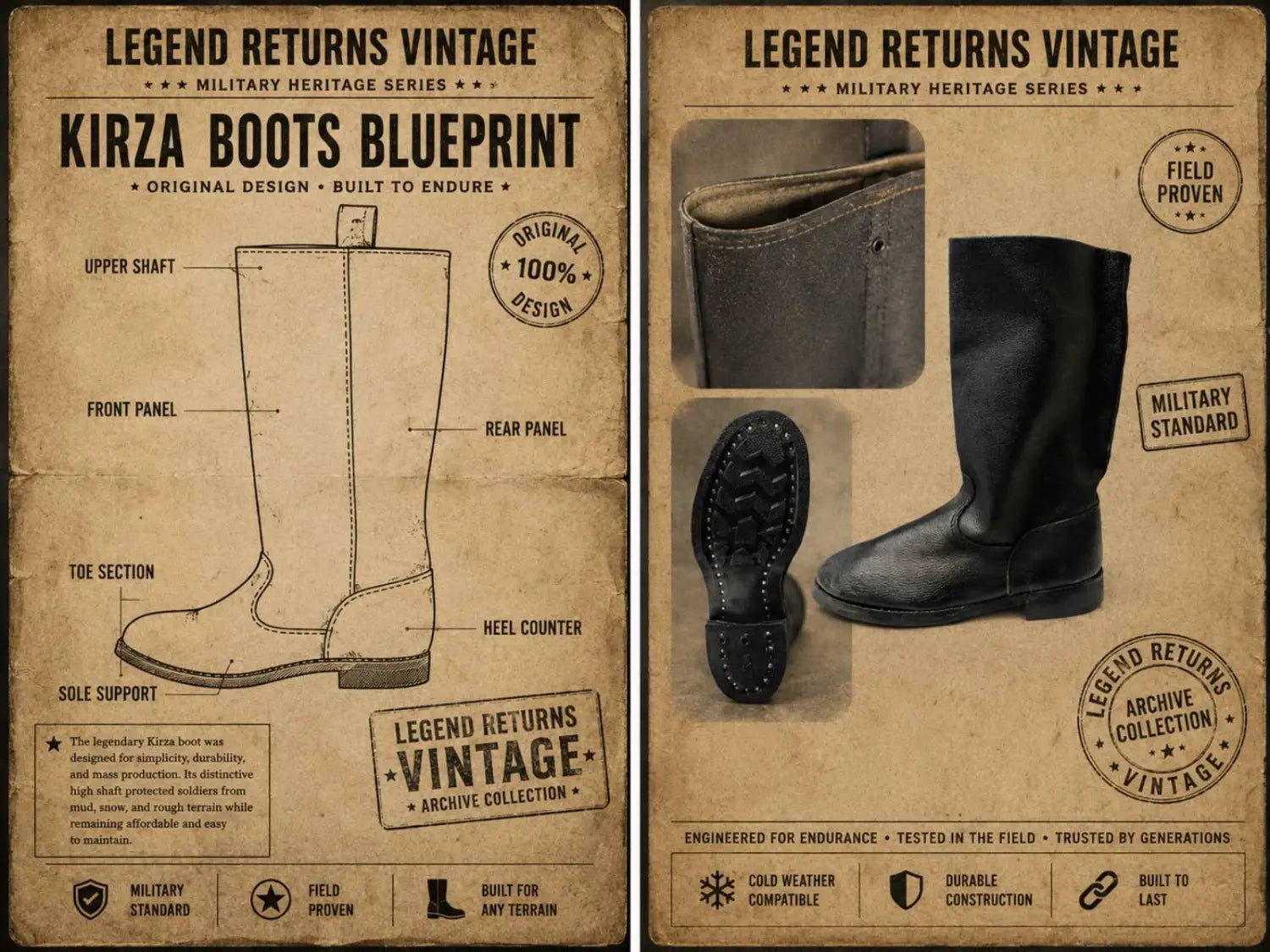
It is a story about soldiers marching across battlefields, workers rebuilding cities, and generations of people relying on a simple pair of boots to carry them through everyday life.
More than a century after the first experiments that led to its creation, the Kirza boot remains one of the most recognizable symbols of Soviet material culture.
Its legacy survives not because it was luxurious or fashionable, but because it accomplished exactly what it was designed to do.
It served.
And in serving millions, it became history itself.
✦ Preserve History. Own a Piece of the Past. ✦
Discover authentic Soviet militaria at Legend Returns Vintage.
Carefully selected historical items for collectors, reenactors, museums, film productions, and vintage enthusiasts worldwide.